Category Archives: improvisation life

trust

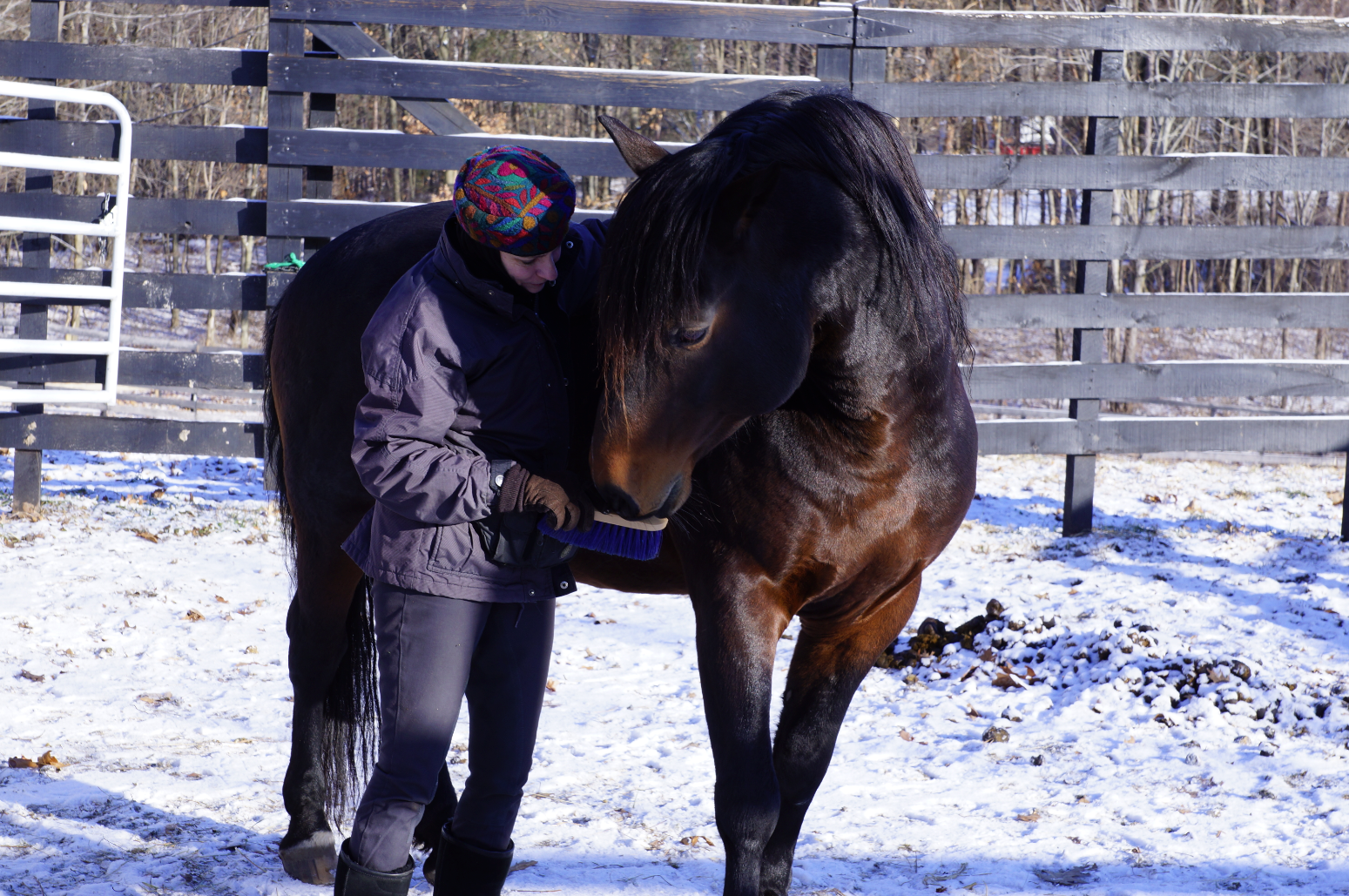
When I first met Nelson, the almost formerly wild Mustang, he did not want to be touched.  He was nervous, and that made me feel nervous, and we did a strange nervous dance for quite a while.  Both of us prickly and alert, sympathetic nervous systems on orange.

I wish I could say that I found a magic key and that suddenly Nelson was easily touchable, but I did not.  What I did find was horse time.  Horse time is biologic, sometimes even geologic.  It does not have to do with any kind of human time measurement.  It has to do with listening and with waiting.

I got very good at waiting.  One day when I came to work with him, Nelson would not let me anywhere near him.  So I sat leaning against the fence for about 2 hours until he finally came close enough to get a treat.  I had a lot of time that day to think about taking that personally.  A lot of time to feel my impatience and what I assumed was my ineptitude.

The real thing that I have learned from Nelson is that if I listen and wait, he gives me everything.  And the lovely thing is that I have also found that to be true about myself.  If I listen and wait, then what I want unfolds and offers itself to me.  All in good horse time.

SHARE & EMAIL

cookbook for the bonehouse: upcoming workshop

I don’t usually do an out-and-out pitch, but for those of you who have been wanting a non-digital, deeply physical experience, this is it.

MOVEMENT FOUNDRY presents

COOKBOOK FOR THE BONEHOUSE

an improvisation workshop for dancers and performing artists


with PAULA JOSA-JONES, MA, CMA, RSME/T


SUNDAYS, March 25th & April 1st,  3:00 pm – 5:00 pm

 A two-day workshop that takes a playful and strategic approach to movement, voice and performance. For the past twenty-five years, Paula Josa-Jones has developed a “cookbook” of wild play “recipes” that she uses to challenge and focus dancers. Techniques include: development of personal, kinetic imagery; the power of stillness; the palette of dynamic space; internal phrasing; initiation and beyond; a thousand voices (a “chunking down” practice that brings greater clarity and differentiation to the body); shape shifting; listening and responding.

CLASSES TAKE PLACE AT

The Dance Complex, 536 Mass Ave. Cambridge 02139

COST
$30 for both classes / $18 a la carte

HOW TO REGISTER
Please email movementfoundry@gmail.com to reserve your spot.

You will be asked to pre-pay for your classes by check. Mailing address will be provided.

PLEASE NOTE
Participants interested in taking both classes will be given registration preference.
Maximum capacity: 22 students per class

FOR MORE INFORMATION VISIT
WWW.MOVEMENTFOUNDRY.YOLASITE.COM

shadow dancing

I have been shadow dancing this morning.  It is a strategy that I suggested to some of my students:   to overcome creative inertia, try dancing around it.  Or diving into it.  Or changing the station.

Dancing around it means that I am doing the opposite of honing in.  I am shifting focus, paying attention to whatever is flickering at the edge of consciousness and being lighter, more fluid and delicate in my physical self.

There is a tendency when writing or working here – in this digital place where we meet – to get stolid, turgic, thick-feeling in the body.  So finding ways to bring in lightness and less density is a good way to shadow dance.

How do you engage your playful body as you are working?

begin again

This morning I entered the day with my camera.  Diving into the work from a different end of the pool.  Finding stillness  and a beginning through the lens.

Sometimes I think that beginning again is like climbing a summit.  Lots of sweaty, hard work to get to a new place.  I forget that it can be effortless.  A breath is a beginning.

I have been writing a lot about something that Abraham calls “segment intending.”  It is one of the processes from Money, and the Law of Attraction. What it means is that each time you shift an activity, you are conscious that you are leaving one segment – one chapter or scene – and entering another.  For example, if I am writing this blog, and the phone rings, then I am leaving the writing and starting a phone segment.

The next step is to bring a sense of intention to that next segment.  Just being aware is plenty.  If it is a phone call, then setting an intention to be present and patient is a good one for me (who tends to be impatient and wanting to be somewhere else).

So this morning, starting the day with a different point of entry – the camera- was a way to find a new perspective.  I also set an intention that I would dip into into seeing and feeling first thing.  Beginning with a different feeling in the body – striding across the field BEFORE sitting to write.

How do you begin?