Category Archives: improvisation life

the dark side of the moon

This is not just a story about a horse.  It is about the commute from what we know to what we do not know.  What we fear.

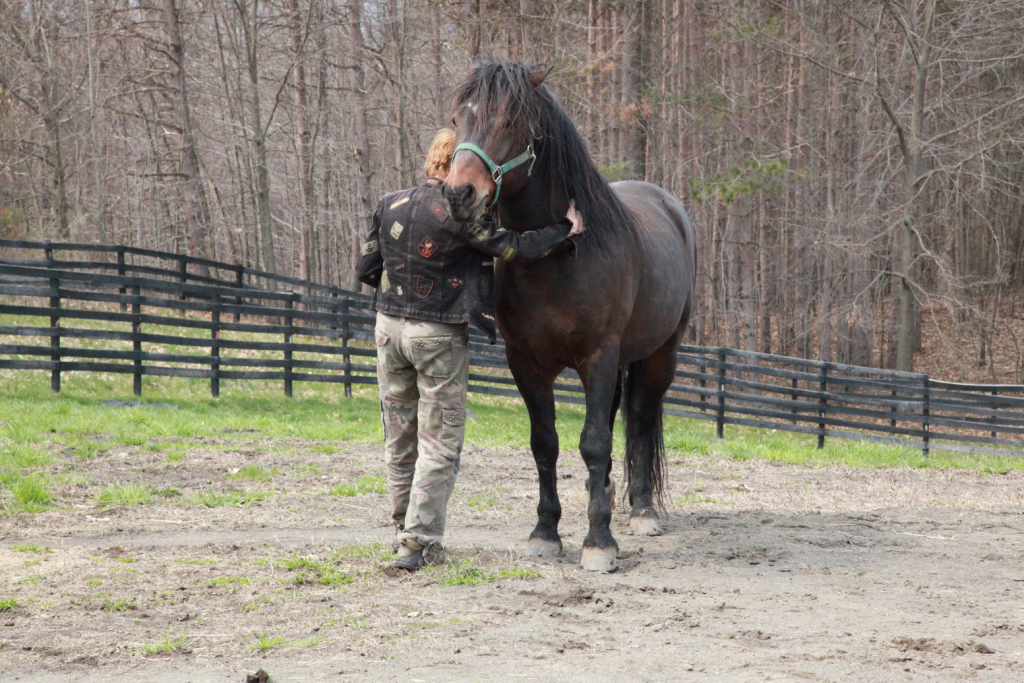
For a long time this picture shows the only way that I could touch Nelson on his left side.  He would not let anyone stand on his that side.  That was where he had been freeze-branded by the BLM after his capture.  Who knows what else had happened there.  It is like the dark side of the moon – the part we can’t see.  Unexplored, alien.

Over time, I got him to let me move to that side.  Usually by walking around his tail and walking calmly toward his head.  But every time I would do it, he was nervous.  As if it were the first time, and someone showing up on that side was a nasty surprise.

Today was that way.  I haven’t seen Nelson for a couple weeks, and when I walked around and stood on his left and went to touch him on that side, his skin jumped, and he spooked off.  Like a boogeyman had popped out of the ground there.  I did it again, and he was still nervous, but let me touch him.  I clicked and gave him a treat (he is moderately Clicker Trained).

As I went to touch him again, a curious thing happened.  I felt myself drop into what felt like a warm lake of calm, as if I had stepped into my avatar, who possessed transformational powers.   “What’s this?” I thought.  Nelson dropped his head, and relaxed.  Immediately.

Because their vision is not binocular in the way that ours is, horses experience the two sides of their bodies differently.  When you introduce something on one side, you have to do the same thing on the other side, because that side has not processed the information.

I often imagine that I am like Nelson in this way.  One side that is pretty mellow and can handle what comes along.  The other side that is spooky and weird.  Not exactly Jekyll and Hyde, but  disconcerting to those who live with me nonetheless. It is almost like falling out of being a predator and into being prey.  Back and forth.  Actually, I think most of us do this all the time.  “I’m safe.”  “I’m going to die.”  Back and forth.

After my calm warm lake moment I could touch him all over.  We were both breathing.  I felt these huge blooms of love for him.  That is, in fact, the glue – the tether – the thing that smooths the journey from one side of the moon to the other.

How do you commute?


SHARE & EMAIL

the herd and us

Pam White “Missouri Mud Run”

Yesterday when I was riding the Arabian that lives in a field down the road all by itself got loose. He came tearing down the road to visit the horses at our farm. Brandi told me that everyone out in the fields was galloping from excitement, and I should probably stay in the indoor arena.  Capprichio, the horse I was riding, didn’t need to see the horses to feel all that energy. He arched his neck and strutted.  The loose Arab ran up and down the road, tail flagging.  Everyone else galloped in their fields with their tails up.  “This is fun.” they seemed to be saying.  “Let’s play!!”  Finally the lonely, running horse was caught, and things settled down.

We are herd animals too.  But I am not sure we have as much fun as the horses.  Sometimes I think that we just want to get back to our computers instead of partying down when one of us gets loose and running.

Flash mobs want to be herd-like, but they are planned, choreographed. Other kinds of herds are more scary, mob-like.  Things that get large numbers of us running are also scary.  9/11, tsunamis, earthquakes.  This is the problem with being predators.  It takes natural disasters to get us going.  One loose human doesn’t do it, unless of course, they are armed.

Herds are curious things. With horses, signals get passed almost invisibly with movement.  A twitch of an ear, a look, a sudden start, or a mosey travel like ripples through the herd.  They all mean something.  “Look out!”  “Better grass here.”  “Get away from my mare!”

We are much less savvy movement-wise.  From the horse’s perspective, we are bumblers, clomping along meaninglessly, much noise signifying not much.

That is why I recommend horse dancing.  It is about waking up to the ripples we make and the ripples we feel.  Learning to be better herd-speakers, learning to feel the currents among us.

How do you feel your herd?


the ham of god

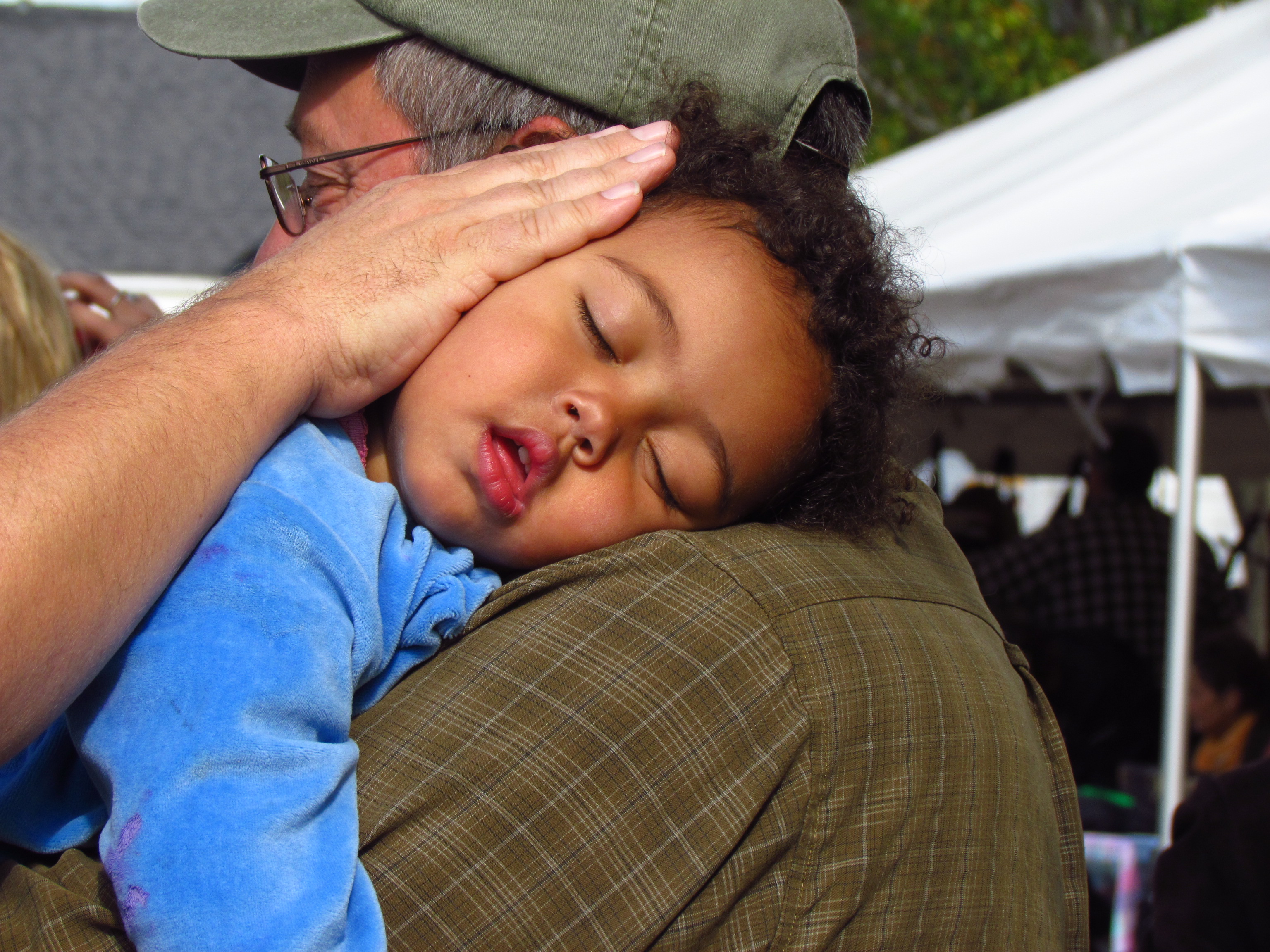
I took this picture at the Putney School Harvest Festival two weeks ago.  I want to sleep like this.

I fell asleep last night laughing out loud listening to Anne Lamott’s Plan B:  Further thoughts on Faith.  Laughing into sleep is a great way to wake up.  When she talked about receiving a providential gift ham on her birthday at a grocery store, I lost it.  She wondered if it was “the ham of god.”

I am finding more ways to soften before sleep, and to soften into waking.  I find that it makes for a more fluid, creative day.  Abraham calls it “getting into the vortex.”  I have been listening to Abraham for about two years now, driving everywhere.  It is the best way that I have found to release resistance.

Resistance is on my mind as I am reading The War of Art. More about that tomorrow.

Abraham says find something to make you happy.  Last year, Emily Jones, the head of the Putney School encouraged students to look at something beautiful and let it make you happy. I have a long list, that includes horses’s noses, cat’s fur, my  daughters’ and Pam’s faces.

What makes you happy today?


the geese, the spiral

M.C. Escher “Day and Night”

Outside this morning with the dogs, and heard the geese from far far away.  Phalanxes of them, high then arcing into slow drifting circles disappearing into the mountain and then reappearing as the light struck their pale chests, and then spiraling, floating down onto the lake.

A second flock approached, and the  spiral downward toward the lake suddenly bloomed into another spiral and then another, each cancelling our the other until finally the whole group seemed to decide on a trajectory and disappeared over the crest.

I thought about spirals.  About DNA.  About the simple spiral of turning to look upward and over my shoulder at someone I love.  About teaching students how to get up from the floor on the refreshing breath of a spiral, with its change of scenery along the way, rather than the jerk and pull default.

I thought about my forward facing-marching-driving-data entering selves.

Today’s question:  Can you find a spiral?   Can you ride a spiral?  And how does that change your point of view?